Loro Piana Isn’t a Status Symbol. It’s an Efficiency Tool.
Most people assume Loro Piana is about status. After five years of buying fabric and finished pieces for a 75-person design studio, I think that’s backwards. Luxury isn’t softness. Luxury is a system that doesn’t waste your time.
I’m the office administrator for a boutique that does high-end interior styling plus a small custom clothing program for clients. I handle all the purchasing—roughly $300,000 a year across 14 vendors. I report to both operations and finance, which means my real job is making sure the right product shows up at the right time with paperwork that doesn’t get rejected. In that context, Loro Piana isn’t a splurge. It’s a way to avoid the little fires that eat your afternoon.
The best way to explain this is to walk you through a bad decision I made in 2024.
The cheap fleece that cost me a week of my life
We needed a soft layering fabric for client blankets. A regional mill offered us something they called northwestern fleece at about a third of the price of our usual wool. The wholesale price difference saved us maybe $600 on the first order. That looked great on the spreadsheet, so I ignored my gut and placed a test order.
It pilled after two washes and shed fibers all over a dark sofa. The vendor’s care instructions were one line: “spot clean only.” No solvent recommendation, no temperature guideline, no explanation of what the fabric was actually made of. I’m not 100% sure the term “northwestern fleece” means anything consistent—maybe a good mill makes a good version of it—but this one wasn’t it. The client ended up with a blanket that looked old after a month, and I ended up on the phone for three days trying to get a refund that never fully came.
Looking back, I should have asked for a larger sample and wash-tested it before scaling up. But the real lesson wasn’t about sampling. It was about information. A premium supplier gives you what you need to make a decision before you commit. That budget supplier gave me a two-word fabric name and a shrug.
What “efficiency” actually means in fabric buying
People hear efficiency and think it means cutting corners. It doesn’t. It means fewer emergency calls, fewer chargebacks, fewer disappointed clients. When our studio expanded from one location to three in 2022, I had to centralize how we ordered everything from office supplies to fabric sample yardage. The vendors who made that easy were the ones I kept. The ones who made it hard got cut. Before that, I treated every order like a one-off. I compared three prices and picked the lowest quote. It looked responsible, but it meant re-explaining our specs every time, re-approving the same details, and re-discovering which supplier didn’t label their boxes. That isn’t buying; that’s doing unpaid work for your vendors.
Product descriptions that don’t lie
In 2024, I processed 160 POs for everything from upholstery yardage to a single mens linen blazer. Loro Piana accounted for maybe a dozen of those orders, but they generated almost zero follow-up emails. That’s not magic; it’s data hygiene.
When a client asks for a mens linen blazer, I can order Loro Piana’s linen and know exactly what’s coming. Fabric weight, drape, crease behavior—most of it is in the line sheet before I even call. With other mills, “linen” has meant everything from a heavy bottom-weight to a see-through voile. That difference isn’t aesthetic. It changes cut, delivery, and how I set expectations with the client.
Same with the ready-to-wear items. The Loro Piana Martha silk satin wrap blouse and their maxi charms striped suede sandals are pieces we regularly order for client gifts and styling work. I don’t have to guess whether “satin” means charmeuse or duchesse. The spec is there, and the product matches it. That consistency is rare.
Care instructions that actually exist
One of the most common questions our team gets is how to clean faux suede upholstery fabric. Most upholstery yardage in the U.S. isn’t covered by the FTC’s Care Labeling Rule (16 CFR Part 423), so a lot of suppliers don’t put care instructions on the bolt. One vendor’s official answer was literally “dab with cloth and hope.” I wish I were joking.
With better mills, care guidance is part of the product data. It may not always be in a consumer-facing label format, but it’s in the order documentation. This sounds minor until an intern uses water and a brush on a faux suede sample and ruins it. When you buy better, you’re buying the answer to that problem before it happens.
Earlier this year, we received a faux suede upholstery fabric from a higher-end mill with a one-page care sheet that included a recommended solvent and a warning about heat. I scanned it, saved it, and attached it to the client’s folder. That’s the difference. The fabric didn’t cost less, but the total cost of owning it did.
Paperwork that doesn’t bounce
This is the one nobody talks about. A vendor who sends a handwritten receipt or a PDF with no PO number costs real money. In 2023, one supplier’s sloppy invoice got rejected by finance and I ended up eating $2,400 out of the department budget because the order had already been expensed. That doesn’t happen with Loro Piana. Their invoices are electronic, line-itemed, and match the original PO. That saves our accounting team hours every quarter.
I once had a vendor send a PDF with no PO number, no billing address, and a total that didn’t match our order. Finance rejected it. I had to rework the PO, then the vendor resent the wrong amount. That one invoice took four weeks to settle. Meanwhile, the Loro Piana order placed on the same day was in our system and reconciled within a week.
Look, I’m not saying Loro Piana is the only brand that does this. But in my experience, the price gap is mostly tied to how much work they take off your plate—not to the softness of the cashmere.
What about the “you’re just rationalizing luxury” argument?
“You’re just making peace with a luxury markup.”
Fair. There is absolutely a brand premium in there. I’m not going to pretend otherwise. But here’s the thing: I’m not a consumer buying a scarf. I’m someone whose job depends on not having to redo things. Every hour I spend chasing a vendor is an hour I’m not processing orders for the rest of the office. In that math, a 30% higher unit price can be the cheaper option.
That doesn’t mean premium always wins. This worked for us because we have predictable ordering patterns and enough volume to make the pricing work. If you’re a one-person shop making a single purchase, the calculus is probably different. Your mileage may vary—but the principle doesn’t: what you’re really paying for is the system around the product.
Bottom line
Nobody ever lost their job for buying Loro Piana. You might lose your afternoon, your expense report, and your credibility with a client if you buy from the wrong budget vendor instead.
So call it status if you want. I call it efficiency. And in my job, efficiency is the only luxury that actually matters.
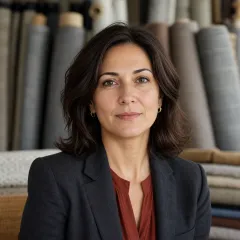
Lucia Bianchi
Lucia Bianchi is a woven apparel-fabric analyst covering cotton, linen, wool, rayon, denim, shirting, twill, satin, poplin, and blended garment fabrics. She applies the ISO 1833 series for fibre composition and ISO 105-C06 for laundering colourfastness while checking GSM, yarn count, usable width, shrinkage, skew, shade grade, drape, and surface defects. Her specification guides help designers, sourcing teams, and mills align fibre claims, lab dips, bulk tolerances, care conditions, and garment performance before production approval.